January 30, 2025 · Angelique
The Complete Guide to Puppy Nutrition: Building a Foundation for Lifelong Health
The Complete Guide to Puppy Nutrition: Building a Foundation for Lifelong Health Is your puppy’s bowl setting them up for success? In this comprehensive guide, we’re diving deep into puppy…

A puppy's feeding plan needs to do more than produce an appealing bowl. It must provide appropriate nutrition for growth, supply enough energy without encouraging excess weight, and fit a routine the family can follow consistently. The food's form—raw, gently cooked, canned or dry—is one part of that decision. The exact recipe, the puppy and the way it is fed matter just as much.
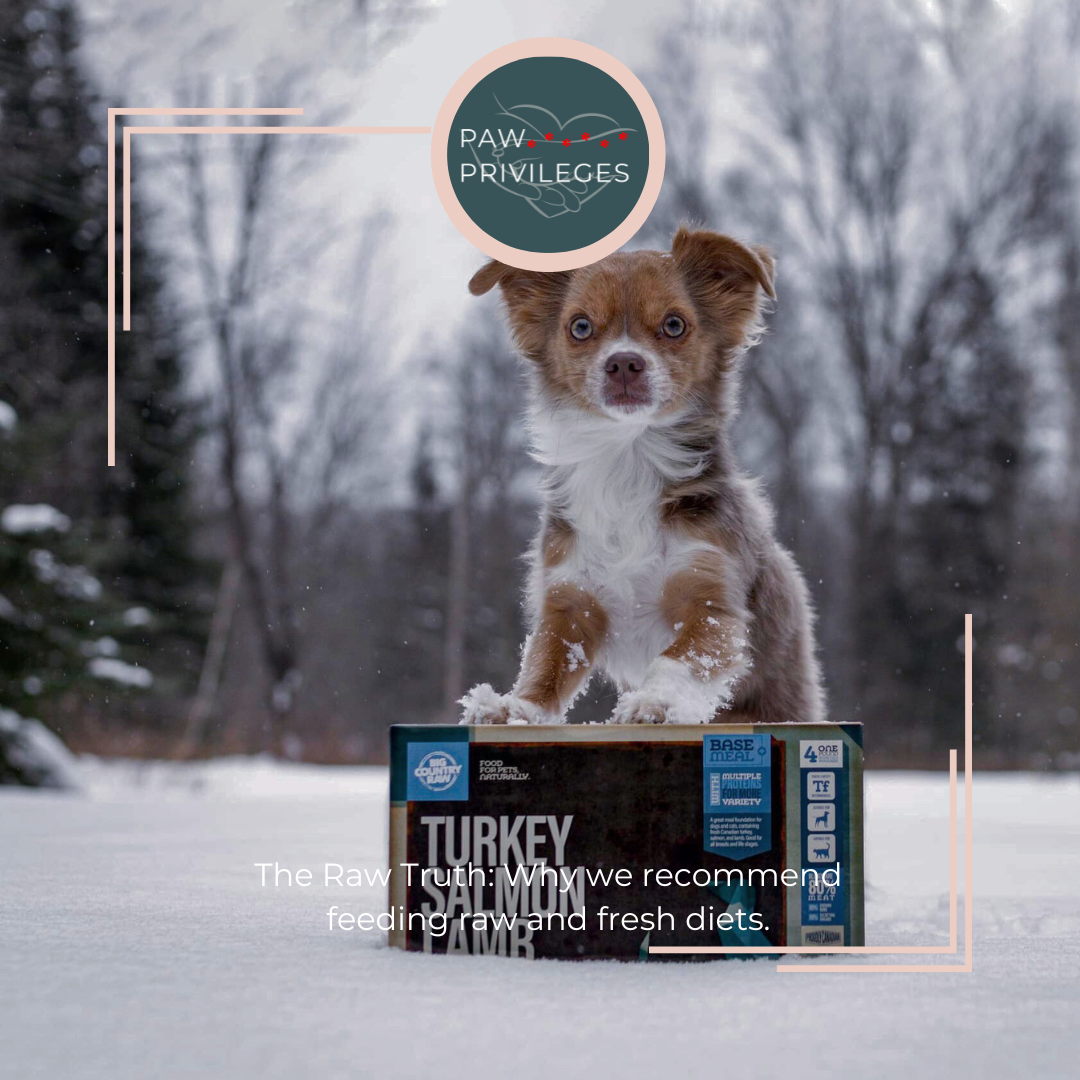
Paw Privileges supports thoughtful fresh and raw feeding and partners with Big Country Raw. That relationship does not mean every recipe is appropriate for every puppy. This guide explains the questions to answer before choosing a food, adding toppers or changing portions.
Start with the nutritional statement
Check that the food is intended for dogs and is complete for growth or an appropriate all-life-stages use. Read the entire nutritional statement, including any qualification about large-size dogs. An adult-maintenance food, a topper and a meat blend intended for supplemental feeding do not automatically meet a growing puppy's needs. AAFCO's label guide explains nutritional adequacy and life-stage wording.
Ask the maker what supports its adequacy statement and how its feeding directions apply to your puppy. The ingredient list helps explain what is in the recipe; it cannot by itself establish the final balance of nutrients. A short list of appealing ingredients is not proof of a complete growth diet, just as the presence of vitamins and minerals is not evidence that a formula is poor quality.
Read large-breed qualifications carefully
Expected adult size can change which growth statement you need. Do not use only the puppy's weight today to decide whether a large-breed qualification applies. Discuss expected adult size with the breeder and veterinarian and check the label of each recipe in a rotation.
For example, Big Country Raw's current Chicken Dinner statement excludes growth of large-size dogs expected to reach 70 lb or more as adults. That specific exception matters even though the same statement otherwise refers to all life stages. Read the exact Chicken Dinner statement. A recommendation for a brand should never replace the instructions for its particular recipe.
Continue the breeder's routine while you make a plan
Before pickup, ask for the exact food, amount, meal times and preparation instructions. Record the puppy's most recent weight and what the breeder has observed about appetite and stool. This gives you a starting point and avoids changing the home, food and schedule all at once without knowing what was normal.
If a change is needed, agree on a transition suited to the puppy and both foods. A fixed internet schedule is not a requirement that overrides illness, a prescribed diet or a food the puppy cannot tolerate. Ask for help if the puppy becomes unwell rather than continuing a transition simply to finish a calendar.
Use calories and measurements to understand portions
Food weight is not the same as energy. Two recipes can supply different calories in the same number of grams, and a cup is not a universal unit across foods. Begin with the manufacturer's growth directions and an individual plan from the people overseeing the puppy's care. Then measure the food consistently.
Here is an arithmetic example, not a recommended puppy ration. If an agreed plan calls for 600 calories from a particular food and the food supplies 200 calories per 100 g, the daily amount is 300 g. If that plan divides the day into three equal meals, each meal is 100 g. A different calorie density or feeding target changes the result. This is why “a percentage of adult weight” alone cannot settle every puppy's portion.
Keep a simple log of the amount actually eaten, extra treats, weight changes and questions. Feeding directions are starting guidance that may need adjustment for the individual animal, as AAFCO's food-selection guidance explains. Review growth and body condition with your veterinarian instead of increasing portions only because the puppy finishes quickly.
Keep toppers and supplements within the plan
A spoonful of something new is still part of the day's diet. Training treats, milk, broth, oils, eggs and chews can add up when several people feed the same puppy. Write down all the extras before deciding that a food is not satisfying or that the puppy needs an additional supplement.
Many veterinary nutritionists use a limit of around 10% of daily calories from treats, with more specific restrictions where needed. Cornell discusses how excess treats can displace balanced food. A complete growth diet should not be substantially replaced with an assortment of unbalanced additions.
Do not add calcium, vitamin-mineral powders or multiple overlapping supplements simply because the puppy is growing. Ask what nutrient is needed, how much the existing diet already provides and who has calculated the combined intake. A homemade or base-blend diet needs a properly formulated plan, not a collection of ingredients that seem healthy individually.
Make storage and hygiene part of the feeding choice
Fresh and raw feeding requires a realistic plan for cold storage, thawing, preparation and cleanup. Check the manufacturer's directions and choose portion sizes the household can use within the stated time. Use dedicated utensils, clean feeding areas and wash hands after handling food.
Raw products can carry harmful bacteria, and freezing or careful handling does not make them sterile. Canada's public-health guidance advises against raw pet food because of infection risk and identifies households with young children, older adults, pregnancy or weakened immunity as needing particular caution. Discuss the household as well as the puppy when choosing a diet. Read the Public Health Agency of Canada's pet-food guidance.
Watch the puppy, and know when to ask for help
Look for a consistent overall pattern rather than using one sign as proof that a diet is ideal. A shiny coat or small stool cannot verify every nutrient in the bowl. Keep regular growth checks and raise persistent digestive changes, poor appetite or unexpected weight changes with your veterinarian.
Repeated vomiting, marked weakness, blood in stool or an inability to keep water down needs prompt veterinary advice, especially in a young puppy. Bring the food label, feeding record and list of supplements or treats so the conversation starts with clear information.
Your next feeding decisions
- Confirm the exact recipe and complete-growth statement.
- Check any large-breed qualification.
- Record the daily amount, calories and meal routine.
- Count every topper and training reward.
- Follow storage and handling directions.
- Review growth and body condition and adjust with appropriate guidance.
Use Feed Wise to organise comparisons, and keep the breeder's handoff information with your puppy's records. A dependable plan is one you can explain, measure and review as the puppy grows.