
November 2, 2026
Whitehorse at Walking Pace: Three Nights in the Yukon With Your Dog
A quieter Yukon getaway with riverside walks, outdoor art and a small pet-welcoming B&B, plus the meal, transport and winter details that make it workable.

Spend three nights in Whitehorse with your dog, staying at Hidden Valley Bed & Breakfast and exploring the Yukon River paths and downtown public art. This small-scale Yukon getaway combines a quiet base with daylight outings, practical meal stops and a shorter winter version when the weather calls for it.
The B&B has shared spaces and firm dog-supervision rules, so confirm a workable meal arrangement before booking. Once that is settled, the trip needs very little rushing: one base and two full days to explore.
The getaway at a glance
Base: Hidden Valley Bed & Breakfast, 40 Couch Road, Whitehorse.
Length: Three nights, with two full sightseeing days.
Main outings: The Millennium Trail, the downtown Riverfront Trail, and a self-guided public-art walk.
Transport: Your own vehicle, or a rental with written approval for your dog.
Best fit: Travellers happy with a hosted B&B, leashed outings and a flexible schedule.
Season: A straightforward warm-season walking break; a shorter-outings version in winter, subject to conditions.
Build your route with the Pawtastic Vacation Planner, starting with Whitehorse as your base and leaving time for the walks.
A small stay with important dog rules
Hidden Valley Bed & Breakfast has four guest rooms on a five-acre property within Whitehorse's city limits. The operator places it about 19 kilometres, or 20 minutes, from downtown. Its appeal here is the separation between a town outing and a quieter place to return to, rather than a central hotel from which you walk everywhere. Travel Yukon lists it as open year-round and welcoming pets.
Read the dedicated pet policy before choosing a room. Dogs cannot be left alone in the room, go on furniture, enter the dining room or use the children's lawn. Indoors, the policy calls for a lead unless the dog is well trained to remain with its owner. Clean-up and responsibility for damage also apply.
The published pet fees disagree: the dedicated policy says CAD25 for the first pet and CAD10 for each additional pet; the FAQ says CAD25 per pet. Neither clearly states whether that charge is nightly or per stay. Get the total, charging basis and approval for your particular dog in writing with the reservation. This guide does not assume a vacancy or a confirmed room allocation.
The B&B's FAQ says breakfast is included and describes shared kitchen access, with a CAD20 kitchen-use fee and no stove or oven cooking after 9 p.m. Confirm how that fee is applied and where you may eat with a supervised dog. The property explicitly says it no longer has an outdoor hot tub, despite older promotional references.
Sort out breakfast before you book
The combination of “no dogs in the dining room” and “no dogs left alone” matters more than a pet-friendly badge.
For two adults, ask whether breakfast can be served at separate agreed times so one person remains with the dog. Do not assume a breakfast relay works with the hosts' service. For a solo traveller, or a couple wanting to eat together, ask for an approved alternative that keeps the dog supervised without entering a prohibited space. The published early-departure breakfast box is not a promise of daily room service.
Settle the same question for supper. Shared kitchen access does not automatically mean permission to bring the dog into every food-preparation or eating area. If the host cannot offer a workable arrangement for your party, choose a different confirmed pet-friendly stay before committing to travel.
Arrival day: supplies, a short outing, then settle in
Make arrival deliberately light. Allow for collecting the vehicle, groceries and check-in rather than promising yourself a full sightseeing day after a flight or a long drive.
Bring food for simple meals and pack lunches before the two main outings. With two adults, one can shop while the other remains with the dog; solo travellers should arrange an available collection or delivery option in advance rather than assume pets can enter food shops. Do not make an unattended car your dog-care plan.
Once checked in, ask the hosts where dogs may walk on the property and which areas to avoid. Keep this first outing short enough to learn the surroundings and let the dog settle. Set up its own bed on the floor, away from the furniture it cannot use.
If you arrive with spare daylight and energy, save your first glimpse of the river for a brief downtown stop. Otherwise, there are two full days ahead. A three-night holiday has room for an uneventful first evening.
Day two: follow the Yukon River
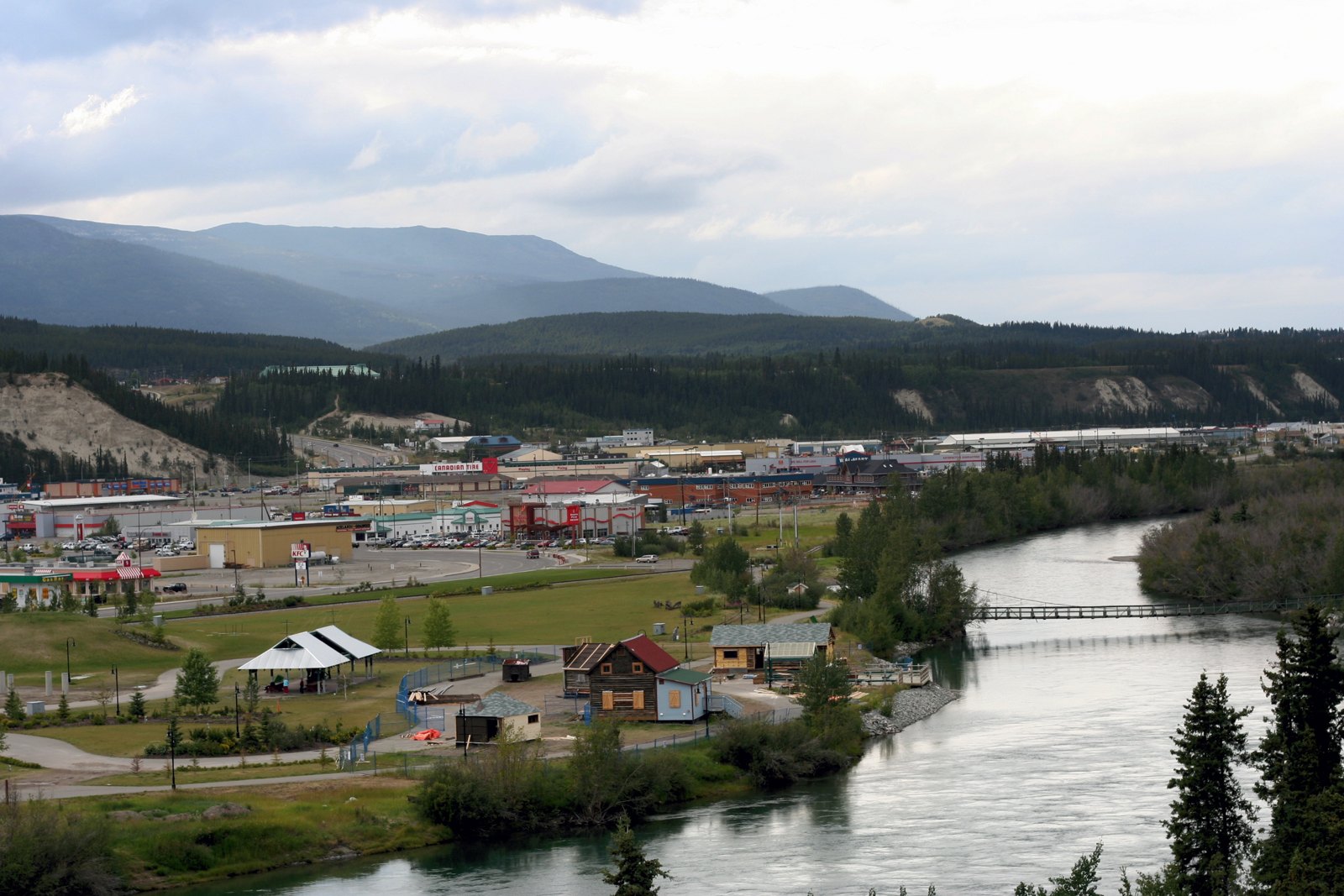
The City of Whitehorse's trail guide describes the Millennium Trail as a five-kilometre paved, non-motorized loop. It follows both sides of the Yukon River, crossing the Robert Campbell Bridge at the north end and the Rotary Centennial Bridge at the south.
That gives this day a clear shape: drive into town, follow the river, cross to the opposite bank, and return without arranging a shuttle. Bring the lunch you prepared instead of relying on finding a dog-welcoming restaurant at exactly the right moment. Keep the lead short enough that cyclists and other walkers can pass comfortably. The city's animal guidance asks owners to keep dogs leashed within Whitehorse boundaries.
Five kilometres is the full route, not an obligation. For an older dog, a new traveller or an uncertain-weather day, choose a simple out-and-back along an open section. Turn around while the dog is still comfortable; do not wait until it is tired and then discover the return distance is the same as the outward one. An out-and-back also makes it easier to judge slippery surfaces before committing to a bridge crossing.
Follow current signs rather than an old saved track. The city completed a Millennium Trail realignment in September 2026; the former section is no longer maintained. Check notices before setting out, especially during spring melt, when the city monitors the downtown escarpment and closures may affect routes near Robert Service Way.
After the walk, head back to your base for a proper rest. This itinerary intentionally leaves the afternoon open rather than adding an unverified dog-friendly attraction. A longer second outing only makes sense if both you and your dog still want one.

Day three: a town walk with something to look for
Use your second full day for a different kind of exploring. The Whitehorse Public Art Map turns a downtown wander into a route with small discoveries along the way. Download it before leaving your room.
Begin around Main Street and the river. The map identifies Healing Totem, by master carver Wayne Price and carvers from Northern Cultural Expressions Society, at Main Street Wharf. At Main Street and Third Avenue, look for Chuck Buchanan's Prospector and his Dog. Take time to read the names and stories rather than treating every work as a quick photo stop.
From the downtown riverfront, make a separate northward stroll towards Shipyards Park if conditions and energy allow. The map lists River Walk by Joyce Majiski at Shipyards Park and Three Bears by Jeanine Baker and Donald Watt along the Waterfront Trail there. You can choose just one cluster; there is no need to collect the entire map.
These are outdoor viewing stops, not a claim that nearby galleries, cultural buildings or shops admit pet dogs. Stay on public paths, respect barriers and give other visitors space. Keep your dog away from artworks, planting beds and any posted restricted areas.
Whitehorse is on the Traditional Territories of the Kwanlin Dün First Nation and Ta'an Kwäch'än Council, as the public-art map explains. The work you encounter belongs to a living community, not simply a gold-rush backdrop. The art walk is a chance to notice more than the familiar frontier imagery.
For picnic supplies, Bullet Hole Bagels lists its shop at Unit 121, 1116 Front Street, with bagels by the half-dozen and sandwiches including smoked salmon and a vegetable-and-cream-cheese option. Its posted hours are Monday–Saturday, 8 a.m.–3 p.m., closed Sunday. Buy supplies before the afternoon gets away from you, and check current hours before going. The bakery also says its bagels are stocked at Wykes’ Independent Grocer, 303 Ogilvie Street.
This is a food-supply recommendation, not a claim either shop admits dogs. With two adults, one can make the purchase while the other stays with the dog; solo travellers should confirm a workable collection arrangement first. Bring a packed-lunch backup on Sundays. In winter, eat back at your accommodation in the host-approved space rather than planning a long outdoor picnic.
Warm weather and winter need different versions
In the warmer months, the river loop and art walk can be the substantial outings. Still check current weather, smoke advisories and trail notices, and shorten the day when conditions warrant. Keep the dog out of the river and away from steep or unstable banks; this is a walking itinerary, not a swimming recommendation.
Winter is workable only with smaller expectations. The city's winter travel page lists snow removal for the entire Millennium loop and for the Riverfront Trail between Robert Campbell Bridge and Spook Creek Station. Clearing is prioritized, not a promise of bare pavement immediately after snowfall. Ice, wind and fresh snow can still change the day completely.
Plan the outdoor portion for daylight, assess the footing before continuing, and return to the B&B when conditions are unsuitable. Do not turn the five-kilometre loop into a winter target simply because it appears on the map. Your dog's coat, age, health and experience all matter; discuss cold-weather needs with your veterinarian rather than relying on one universal temperature limit.
Leave Miles Canyon out of this winter plan. The city's October 28, 2026 notice says Miles Canyon Road is closed to vehicle traffic for the season. A summer driving itinerary cannot simply be reused in winter.
Getting there without creating a transport problem
Hidden Valley is not a downtown walking base. Plan the return drive as well as the outward trip, using your own suitable vehicle or a rental company that has approved your dog and explained its cleaning requirements. No pet-approved taxi or B&B shuttle is assumed here.
Flying is possible, but book the dog's arrangements before treating the trip as settled. Air North's Pets on Jets policy requires attention to limited pet space, the aircraft-specific carrier dimensions and the dog's ability to stand and turn naturally. Checked-baggage and cargo arrangements have separate conditions. An available passenger seat does not establish an available pet space.
For road travel, check Yukon 511 before departure and again before a winter drive. Allow time for conditions rather than promising a fixed transfer time.
Make this Yukon break your own
Build your Whitehorse route in the Pawtastic Vacation Planner. Keep the public-art map handy, and save written confirmation of the pet fee, meal arrangement and vehicle approval separately with your booking documents.
Use the Paw Rewards directory to look for additional Whitehorse stays and services, checking each business's current rules directly. For another region or season, return to Seasonal Adventures With Your Dog Across Canada.
The pleasure of this trip is its manageable scale: one base, two different walking days, and a river that gives both days a sense of place.
Photo credits
Yukon River at Whitehorse: Gareth Sloan, 2008, CC BY-SA 2.0. Whitehorse station: Canadian2006, 2012, CC BY-SA 3.0. Both photographs resized and compressed; each remains available under its stated licence.

Turn this inspiration into a Pawtastic vacation.
Build a free trip itinerary for your dogs, with activities and travel stops. Continue as Guest—no app or account required to plan. Create a free account only if you want to save your plan. Confirm each venue’s current dog policy before visiting.
An active Paw Rewards app account is required to earn and redeem Treats. Guest planning does not earn Treats.


Comments (0)
Loading comments…